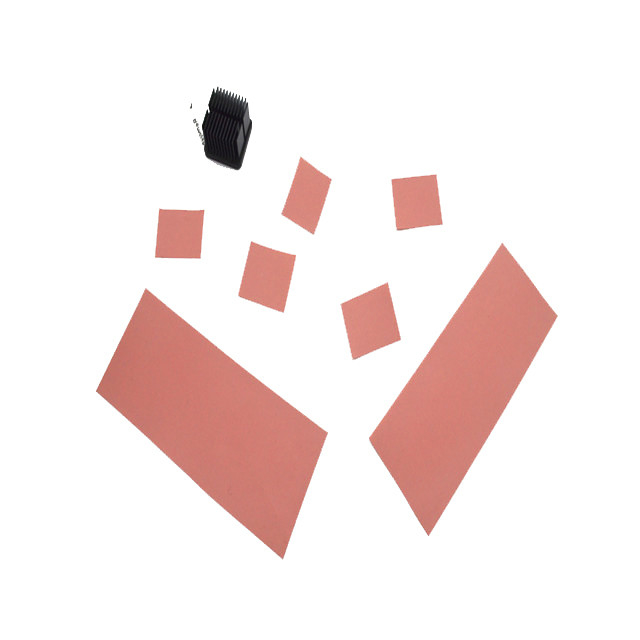
Product Details
Place of Origin: Vietnam
Brand Name: Ziitek
Certification: UL and RoHs
Model Number: TIS100-16-02
Payment & Shipping Terms
Minimum Order Quantity: 1000pcs
Price: 0.1-10 USD/PCS
Packaging Details: 24*13*12cm cartons
Delivery Time: 3-5 work days
Payment Terms: T/T
Supply Ability: 100000pcs/day
Products Name: |
Electrically Insulating Thermal Sheet For Power Supply |
Thermal Conductivity: |
1.6 W/mK |
Color: |
Pink |
Construction & Compostion: |
Ceramic Filled Silicone Elastomer / Fiberglass |
Density: |
1.8g/cm³ |
Recommended Operating Temperature (℃): |
-40~200℃ |
Keywords: |
Electrically Insulating Thermal Sheet |
Application: |
Car Battery & Power Supply |
Electrically Insulating Thermal Sheet For Power Supply
Products description
TIS®️100-16-02 Series is a thermally conductive and electrically insulating product. It achieves insulating and thermally conductive effects by adding insulating silicone-based materials into thermally conductive materials. Meanwhile, the fiberglass provides excellent tear resistance and puncture resistance. The product is non-toxic, environmentally friendly, and flame-retardant. It is mainly used to isolate power supplies from heat sinks, among other applications.
![]()
Features
> Highly thermal conductive 1.6W/mK
> High dielectric strength
> Low thermal resistance with high voltage isolation
> Easy release construction
> Resistant to teaars and punctures
Applications
> Car Battery & Power Supply
> Power semiconductors
> Audio and Video components
> Motor controllers
> Notebook
> Power supply
> Memory Modules
> Mass storage devices
| Property | Value | Test Method |
|---|---|---|
| Color | Pink | Visual |
| Construction & Composition | Ceramic filled silicone elastomer / Fiberglass | ZKTM J024 |
| Thickness range (inch/mm) | 0.008/0.20 | 0.009/0.23 | 0.010/0.25 | 0.012/0.30 |0.018/0.45 | ASTM D374 |
| Hardness (Shore A) | 80 | ASTM D2240 |
| Density (g/cm³) | 1.8 | ASTM D792 |
| Tensile Strength (Mpa) | 40 | ASTM D412 |
| Recommended Operating Temperature (℃) | -40~200 | ZKTM J025 |
| Breakdown voltage (V) | ≥3500 | ≥4000 | ≥5000 | ≥6000 | ≥8000 | ASTM D149 |
| Dielectric Constant @1MHz | 5.5 | ASTM D150 |
| Volume Resistivity (Ohm*cm) | >1.0x10¹² | ASTM D257 |
| Thermal Conductivity (W/m*K) | 1.6 | ASTM D5470 |
| Thermal impedance (℃*in²/W) @25psi | 1.13 | 1.15 | 1.46 | 1.47 | 2.70 | ASTM D5470 |
| Flame Rating | V-0 | UL94 (E331100) |
![]()
Packaging Details & Lead time
The packaging of Thermal Insulation Materials
1.with PET film or foam-for protection
2. use Paper Card To Separate Each Layer
3. export carton inside and outside
4. meet with customers' requirement-customized
Lead Time :Quantity(Pieces):5000
Est. Time(days): To be negotiated
FAQ:
Q: Are you trading company or manufacturer ?
A: We are manufacturer in China / Vietnam
Q: How long is your delivery time?
A: Generally it is 3-7 work days if the goods are in stock. or it is 7-10 work days if the goods are not in stock, it is according to quantity.
Q:What Is a Thermal Interface Material (TIM)?
A:Thermal Interface Materials (TIMs) are used to fill microscopic air gaps between a heat source and a heat sink, reducing interface thermal resistance and improving heat transfer efficiency. Common TIMs include thermal pads, thermal gels, thermal greases and phase-change materials.
Q:What Is Thermal Conductivity? Is Higher Thermal Conductivity Always Better?
A:Thermal conductivity measures a material's ability to conduct heat and is typically expressed in W/m·K. Higher thermal conductivity generally indicates better heat conduction, but actual thermal performance also depends on thickness, interface resistance, compression and contact area.
Q:What Is Thermal Resistance in Thermal Interface Materials?
A:Thermal resistance represents the resistance to heat flow through a material or interface. For TIM applications, actual thermal resistance can be more meaningful than thermal conductivity alone.
Q:What Is the Difference Between Thermal Conductivity and Thermal Resistance?
A:Thermal conductivity describes the intrinsic heat-conduction capability of a material, while thermal resistance also depends on thickness, contact area and interface conditions.
Q:Does Higher Thermal Conductivity Always Mean Better Cooling?
A:Not necessarily. Thickness, interface contact, compression and actual thermal resistance can signi
ficantly affect final cooling performance.
Q:Why Do AI Servers Need High-Performance Thermal Interface Materials?
A:AI GPUs, CPUs and Application Specific Integrated Circuits generate high power and heat flux, requiring efficient heat transfer to heat sinks or cold plates. High-performance TIMs help reduce interface thermal resistance.
Tags: